
Revenue Is a Team Sport: Why Revenue Growth Depends on Cross-Functional Execution
RevGeneration
Read More


Semantic layers and ontologies make business context explicit and machine-readable. Without them, AI fills the gaps with confident guesses.

Author: Andy Vold
Picture a sales leader asking a new AI assistant: “Which customers in the Mountain region are at risk of leaving?” The data is clean, governed, and reusable. The assistant returns three names in seconds.
The list is wrong. Two names are the same company, set up as separate billing accounts. A customer the Mountain team manages is missing because it is billed to an address in Texas. And none of the three meet the business’s definition of “at risk”: a renewal within 90 days combined with falling usage.
The team chases the wrong accounts, the customer that needed attention moves to a competitor, and the sales leader stops trusting the tool.
Nothing was wrong with the data. The AI didn’t know how the business works. Your people carry that knowledge in their heads. AI does not.
As our September article noted, agreeing on what a “customer” is matters. But business questions rarely involve just one term. Answering them takes three kinds of knowledge:
Most organizations have documented definitions in a business glossary or data catalog. Relationships and rules usually live in report logic, spreadsheets, and the memory of long-tenured staff. Experienced analysts fill those gaps without thinking about it. AI can’t.
In a 2023 benchmark built on an insurance company’s database, GPT-4 answered 16% of business questions correctly from the raw tables. Adding a knowledge graph raised accuracy to 54%.¹ A 2024 follow-up used an ontology to check and correct the AI’s work. Accuracy rose to 72%, and on another 8% the AI responded “I don’t know” rather than guessing.² Newer models still benefit: a 2026 rerun of the same benchmark found AI answered 98–100% of questions correctly through a semantic layer, versus 84–90% when writing its own SQL.³
Different studies. Different years. The constant was context.
Semantic Layers vs. Ontologies: what’s the difference?
The terms are often used interchangeably, but they solve different problems. A semantic layer is a shared set of business definitions and calculations, so every report calculates a metric the same way. An ontology is a model of how your business works: the things that matter, how they connect, and the rules between them. Think of the semantic layer as a dictionary and the ontology as a blueprint. A knowledge graph is an ontology filled with your actual data.
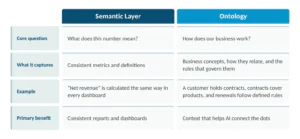
Most organizations need both. The semantic layer keeps numbers consistent. The ontology gives AI the context to interpret them.
Here is how an ontology fixes the sales leader’s answer:
The data didn’t change; the context did. And because that context is defined once, every report, dashboard, and AI tool asking a similar question gets the same answer.
You don’t need to model the entire enterprise. Start small and prove value:
Ownership matters as much here as it did for governance. Business meaning changes as the business changes, and someone must be accountable for keeping it current.
Trusted data builds confidence. Reusable data creates scale. Shared meaning makes data understandable to people and to AI.
If your AI tools give confident answers that miss what the business means, the problem may not be the model or the data. It may be missing context. The question worth asking isn’t whether your data is clean. It’s whether your AI understands what that data means to your business.
Andy Vold is a Senior Architect at RevGen, where he helps organizations build data foundations that support analytics and AI to deliver lasting business impact.


Governance establishes trust, but reusable data creates scale. Learn how organizations can transform data from a byproduct of operations into a strategic asset that delivers value across the business.
Read MoreGet the latest updates and Insights from RevGen delivered straight to your inbox.