AI Agents: The Next Evolution in Enterprise Automation
AI agents are emerging as the next frontier in automation. Unlike traditional AI assistants, these agents can autonomously perform complex tasks, make decisions, and take actions to achieve specified goals.
Following the transformative developments in multimodal AI throughout 2024 which brought advances in voice processing, video analysis, and image recognition, 2025 is positioning itself as the year of AI agents. This evolution represents a significant leap forward from traditional AI assistants and automation tools by introducing systems capable of autonomous decision-making and action.
What sets AI agents apart is their ability to understand and independently pursue goals, rather than simply responding to specific commands. These systems can analyze situations, plan sequences of actions, and adapt their approach based on results and changing circumstances. This represents a fundamental shift from reactive to proactive AI systems.
Key Characteristics of AI Agents:
Goal-oriented execution with minimal human intervention
Autonomous decision-making and task prioritization
Self-determined planning and execution strategies
Ability to interact with various tools and systems
Continuous learning and improvement from outcomes
Memory retention and context awareness
Multi-step reasoning capabilities
Big Tech and AI Agents
Major tech companies are already deeply invested in AI agent development:
Salesforce → Agentforce
IBM → WatsonX
Microsoft → Microsoft Copilot Studio
Google → Vertex.AI
NVIDIA → NIM Agent Blueprint
Amazon → Amazon Bedrock
OpenAI → Operator
Speaking on the “No Priors” podcast, NVIDIA CEO Jensen Huang notes, “there’s no question we’re going to have AI employees [agents] of all kinds.”
This sentiment was echoed by Mark Zuckerberg, CEO of Meta, who envisions an even more expansive future, saying “I think we’re going to live in a world where there are going to be hundreds of millions or billions of different AI agents, eventually probably more AI agents than there are people in the world. A lot of what we’re focused on is giving every creator and every small business the ability to create AI agents for themselves.”
Market Growth and Opportunity
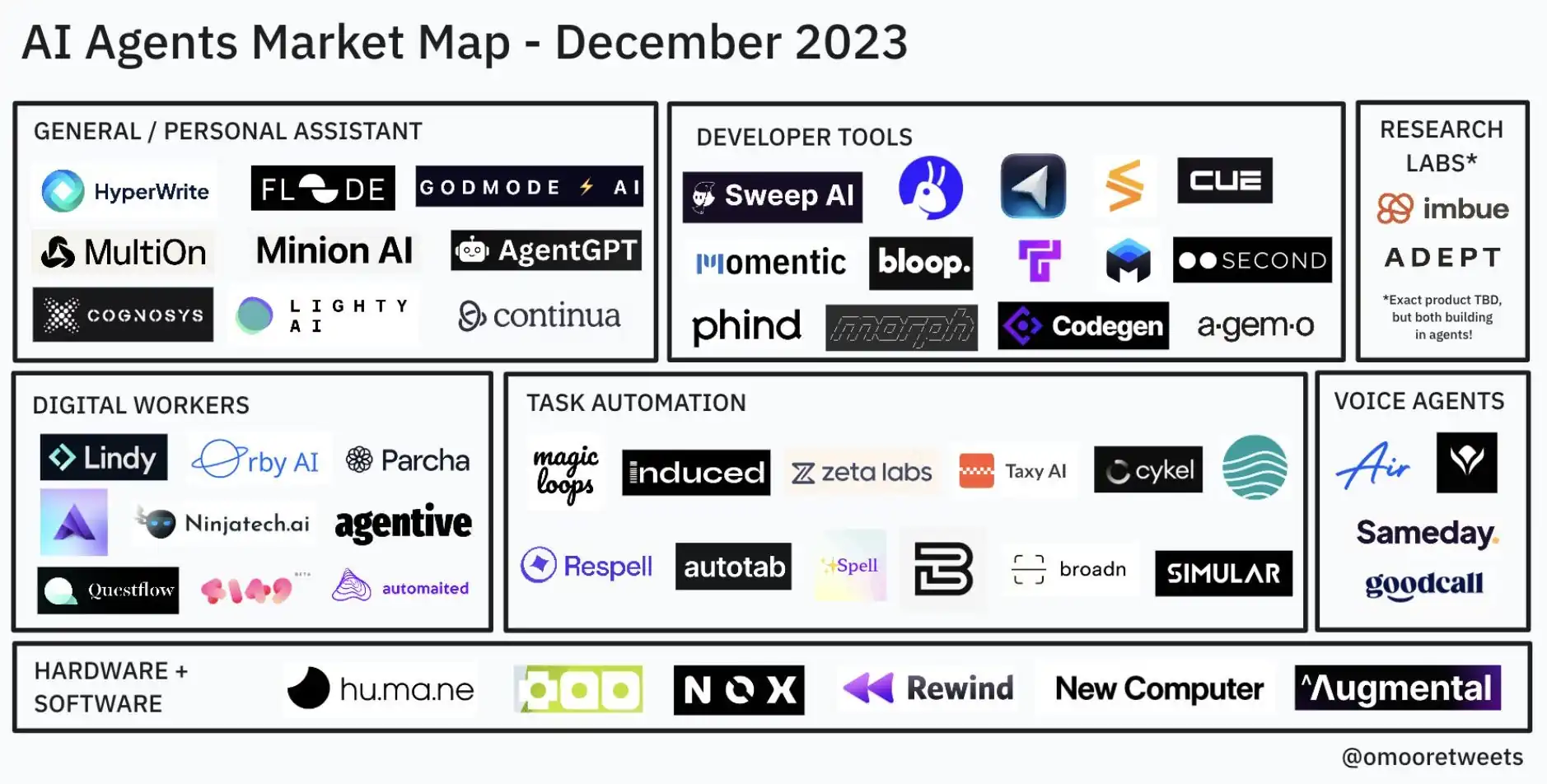
The AI agent landscape has undergone remarkable expansion. In December 2023, there were approximately 50+ AI agents in the market.
Now, Just a little over a year later, this number has exploded to over 900+ agents, demonstrating the growth and innovation in this space. You can browse by agent category here!
This rapid expansion is driven by real business adoption. As evidenced by Salesforce’s CEO on a Yahoo! Finance interview in Q4 2024: “We already sold 200 deals, we’ll do thousands of Agentforce deals this quarter.” The opportunity is large, as noted by Y Combinator’s Managing Partner Hari Taggar in a Lightcone Podcast: “If you can find a boring repetitive admin task, there is likely going to be a billion-dollar AI agent startup if you keep digging deep enough into it.”
Enjoying this insight?
Sign up for our newsletter to receive data-driven insights right to your inbox on a monthly basis.
The evolution of automation and AI solutions can be viewed as a progression through three distinct levels, each building upon the capabilities of the previous:
Examples: Document processing, customer service routing
AI Agents
Autonomous goal achievement strategies
Self-determined planning and execution
Complex reasoning and problem-solving capabilities
Adaptive decision-making based on context
Examples: Sales prospecting, research synthesis, project management
Components of AI Agents
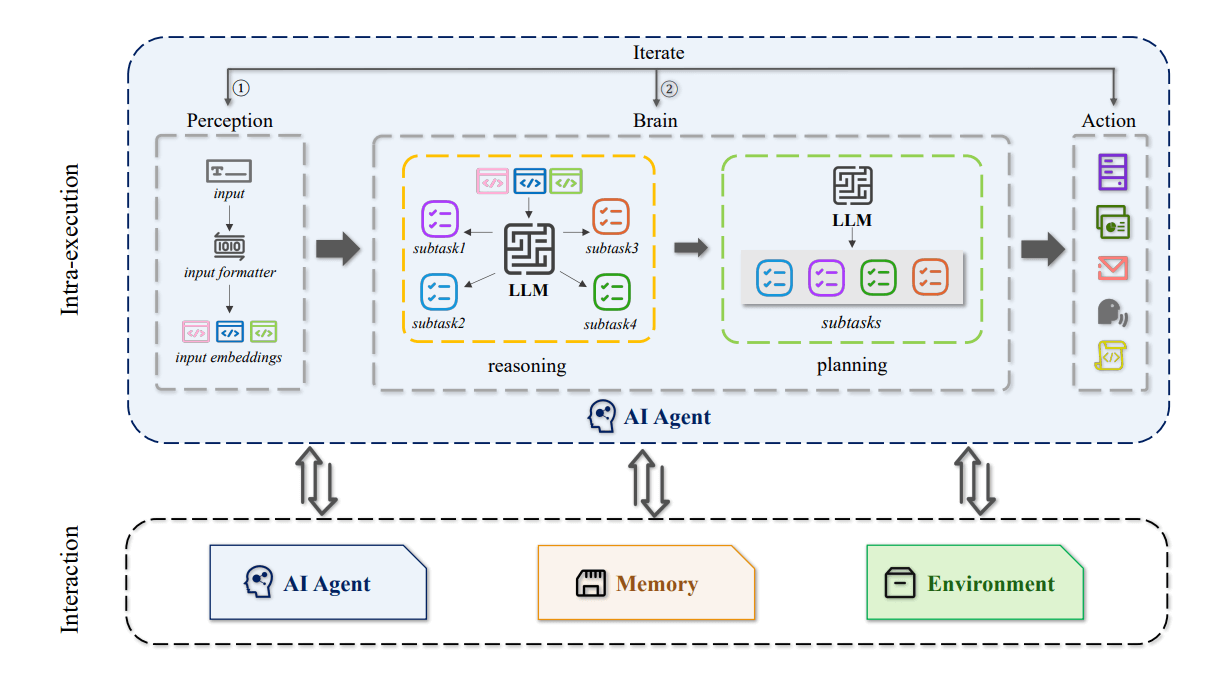
At the heart of every AI agent lies three essential components: perception, brain, and action. As illustrated in the diagram below, these components form a sophisticated processing pipeline while maintaining continuous iteration and interacting with external elements.
The Perception Module – The perception component serves as the agent’s sensory system, processing incoming information through three key stages:
Input reception
Input formatting through specialized formatters
Creation of input embeddings
This initial processing ensures that information is standardized and optimized before reaching the agent’s cognitive center
The Brain: Reasoning and Planning – The brain component represents the agent’s cognitive center, divided into two specialized functions:
Reasoning: Powered by Large Language Models (LLMs), the reasoning system breaks down complex problems into manageable subtasks. These models analyze inputs and draw logical conclusions, creating a framework for decision-making.
Planning: A dedicated LLM handles strategic planning, organizing subtasks into coherent sequences and optimizing their execution order. This ensures efficient resource utilization and goal achievement.
The Action Interface – The final component translates decisions into concrete actions through tool calling and external system interactions. This module executes the planned subtasks, interfacing with various tools and services to accomplish the agent’s objectives.
Interconnected Operation and Feedback – While these components may appear to operate linearly, they form an interconnected system with important feedback mechanisms. The perception-to-brain pathway (marked as ① in the figure) and the brain-to-action pathway (marked as ②) represent critical points where the system can:
Learn from interaction outcomes
Refine its decision-making processes
Adapt strategies based on previous results
Enhance model accuracy and effectiveness over time
The Interaction Layer – Beyond its internal operations, the AI agent can interact with three critical external components:
Other AI agents for collaborative problem-solving
Memory systems for information storage and retrieval
Environmental interfaces for real-world interaction
Enterprise Implementation Reality
While venture capitalists and technology enthusiasts are already discussing advanced concepts like AI agent swarms and fully autonomous business processes, enterprise adoption shows a more measured and practical approach. Most organizations are carefully evaluating how to implement AI agents while maintaining control and ensuring reliability.
The current enterprise landscape reveals:
Experimental implementations in controlled environments
Focus on specific, well-defined use cases
Emphasis on reliability and predictability over autonomy
Preference for vertical-specific solutions with proven results
Gradual integration with existing systems and processes
Current Applications and Opportunities
Early enterprise applications of AI agents demonstrate promising results in several areas:
Sales and Marketing
Automated prospect research and qualification
Personalized campaign management
Market trend analysis and reporting
Operations Management
Calendar and meeting optimization
Document processing and analysis
Resource allocation and scheduling
Project timeline monitoring
Customer Support
Ticket routing and prioritization
Initial response generation
Issue resolution tracking
Escalation management
Research and Analysis
Data gathering and synthesis
Competitive analysis
Market research compilation
Trend identification
Looking Ahead: 2025 and Beyond
As we progress through 2025, several key developments are expected to shape the AI agent landscape:
Vertical Solutions First
Industry-specific applications leading adoption
Focused use cases with proven ROI
Higher reliability in narrow domains
Specialized agents for specific sectors
Multi-Agent Systems
Coordinated agent teams with specialized roles
Hierarchical management structures
Inter-agent communication protocols
Collaborative problem-solving capabilities
Increased Accessibility
More user-friendly interfaces
Low-code/no-code development options
Improved development and management tools
Better integration capabilities
Conclusion
AI agents represent a significant shift in how enterprises can approach automation and task execution. Major tech companies and innovative startups are developing agents for tasks ranging from personal assistance to complex business operations. These digital workers are proving increasingly adept at research, customer service, and sophisticated problem-solving. While the technology is still evolving, organizations can begin preparing for usage by:
Experimenting with vertical-specific solutions
Building internal expertise and understanding
Developing comprehensive governance frameworks
Identifying potential use cases and applications
We’re entering an era where AI agents will become as commonplace as standard business software. Organizations that understand and prepare for this transformation will be well-positioned to harness the potential of these new digital colleagues.
RevGen’s proven track record combining business acumen with deep technical expertise means that we have the experience to design and build AI agents to solve your business challenges. Contact us today to talk about how our AI Workshop can help you understand how you can use AI to create your own competitive advantage.
Macaulan is a Managing Consultant specializing in artificial intelligence, data governance, and enterprise automation. Through his expertise, he helps organizations navigate the rapidly evolving landscape of AI technologies.